


Comparative Performance Analysis of Modern Rice Varieties: Insights from HHAT Trials
Introduction
Rice is the staple food for millions of people in Bangladesh and across South Asia. With increasing climate variability, evolving pest resistance, and the need for higher productivity, the selection of high-yielding, resilient rice varieties is crucial. To address this, the Head-to-Head Adaptive Trial (HHAT) of modern rice varieties has been implemented, bringing together key institutions like the International Rice Research Institute (IRRI), Gopalganj Science and Technology University (GSTU) and the Agribusiness Education and Research International (AERI).
These trials aim to evaluate the adaptability, yield potential, and resilience of modern rice varieties under real field conditions. This post delves into the HHAT trials, analyzing the comparative performance of different rice varieties, the role of partner institutions, and how this research contributes to the future of rice cultivation in Bangladesh.
Understanding the HHAT Trials and Their Importance
The Head-to-Head Adaptive Trial (HHAT) is designed to compare multiple modern rice varieties under uniform field conditions. This method provides a scientific approach to assessing performance in terms of:
• Yield Potential
• Resistance to Diseases and Pests
• Adaptability to Climate Variability
• Economic Feasibility
These trials generate empirical evidence that helps policymakers, agricultural scientists, and farmers make informed decisions about rice cultivation.
Key Institutions Involved in the HHAT Trials:
1. International Rice Research Institute (IRRI)
IRRI focuses on developing high-yielding, climate-resilient rice varieties, supporting sustainable farming practices, and conducting scientific field trials to assess rice variety performance.
2. Gopalganj Science and Technology University (GSTU) & Agribusiness Education and Research International (AERI)
GSTU and AERI play a crucial role in implementing trials, conducting sample crop cutting experiments, and disseminating findings among farmers and stakeholders.
Performance Comparison of Modern Rice Varieties in HHAT Trials


1. Yield Performance
• Certain high-yielding hybrid varieties produced 10-15% more grain compared to traditional varieties.
• Improved IRRI-BRRI developed varieties exhibited better grain weight and panicle length.
2. Resistance to Pests and Diseases
• Some modern varieties showed strong resistance to bacterial blight and rice blast, reducing pesticide use.
3. Climate Resilience and Adaptability
• Drought-tolerant varieties ensured stable yield under low rainfall conditions.
• Flood-tolerant rice varieties performed better in prolonged water stagnation.
4. Economic Feasibility
• Hybrid and IRRI-BRRI developed varieties provided a higher return on investment despite higher seed costs.
• Mechanized transplanting and harvesting reduced labor costs by 15-20%.
Significance of Crop Cutting Experiments in the Trials
Sample Crop Cutting Experiments ensure real-world validation of rice yield potential, strengthening the reliability of trial results.
Implications of HHAT Trials for Future Rice Cultivation
• Adoption of high-yielding varieties
• Promotion of climate-resilient rice
• Integration of modern farming techniques
• Policy recommendations for sustainable rice farming


Empowering Women in Agriculture: The Women-Led Rice Seed Producer Group in Rangamati
One of the most remarkable developments in agricultural empowerment is the formation of a women-led Rice Seed producer group in Rangamati District, an initiative by AERI with support from IRRI and GSTU. This initiative is revolutionizing seed production in remote areas while empowering women farmers to take a leading role in sustainable agriculture.
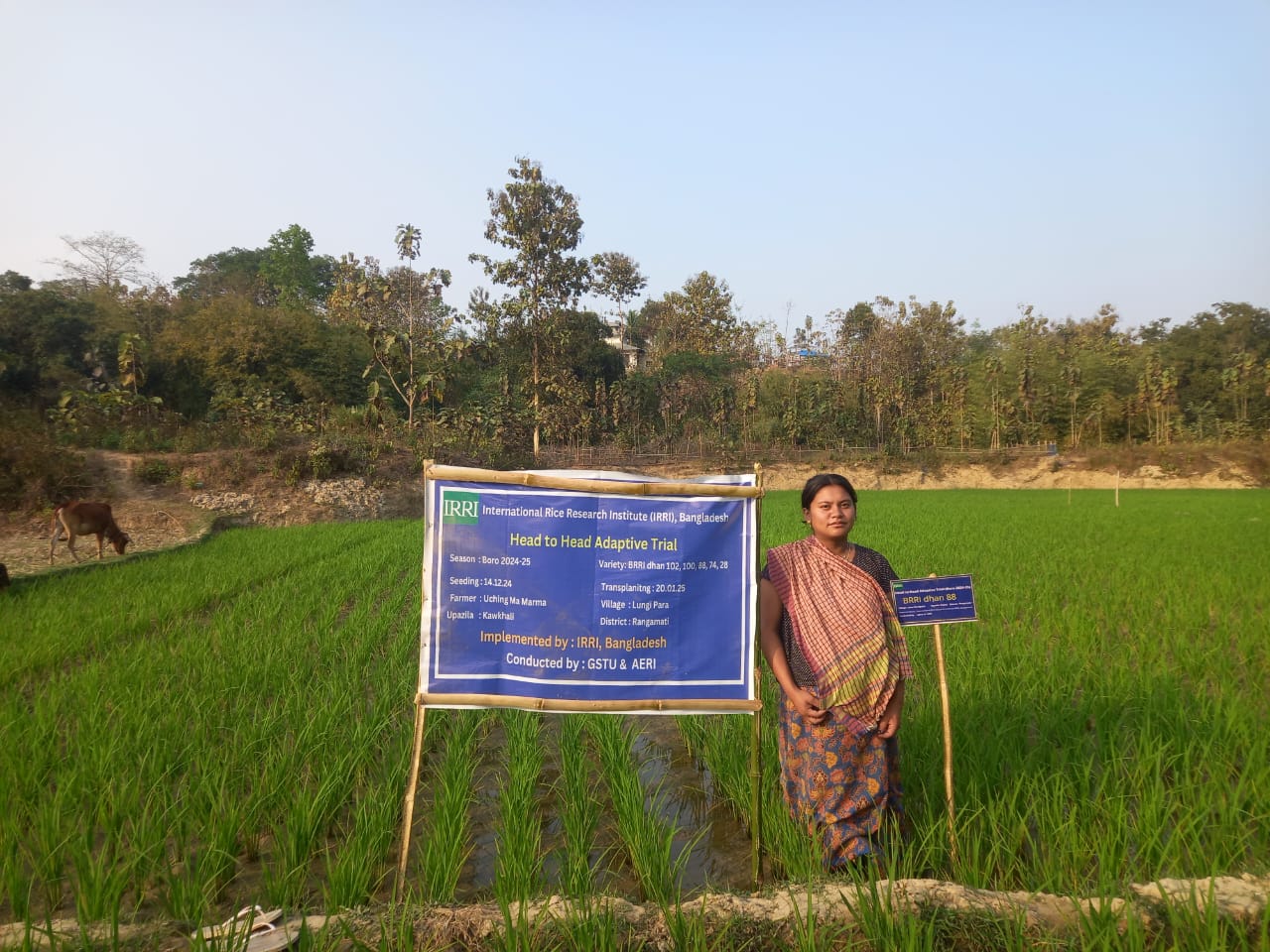
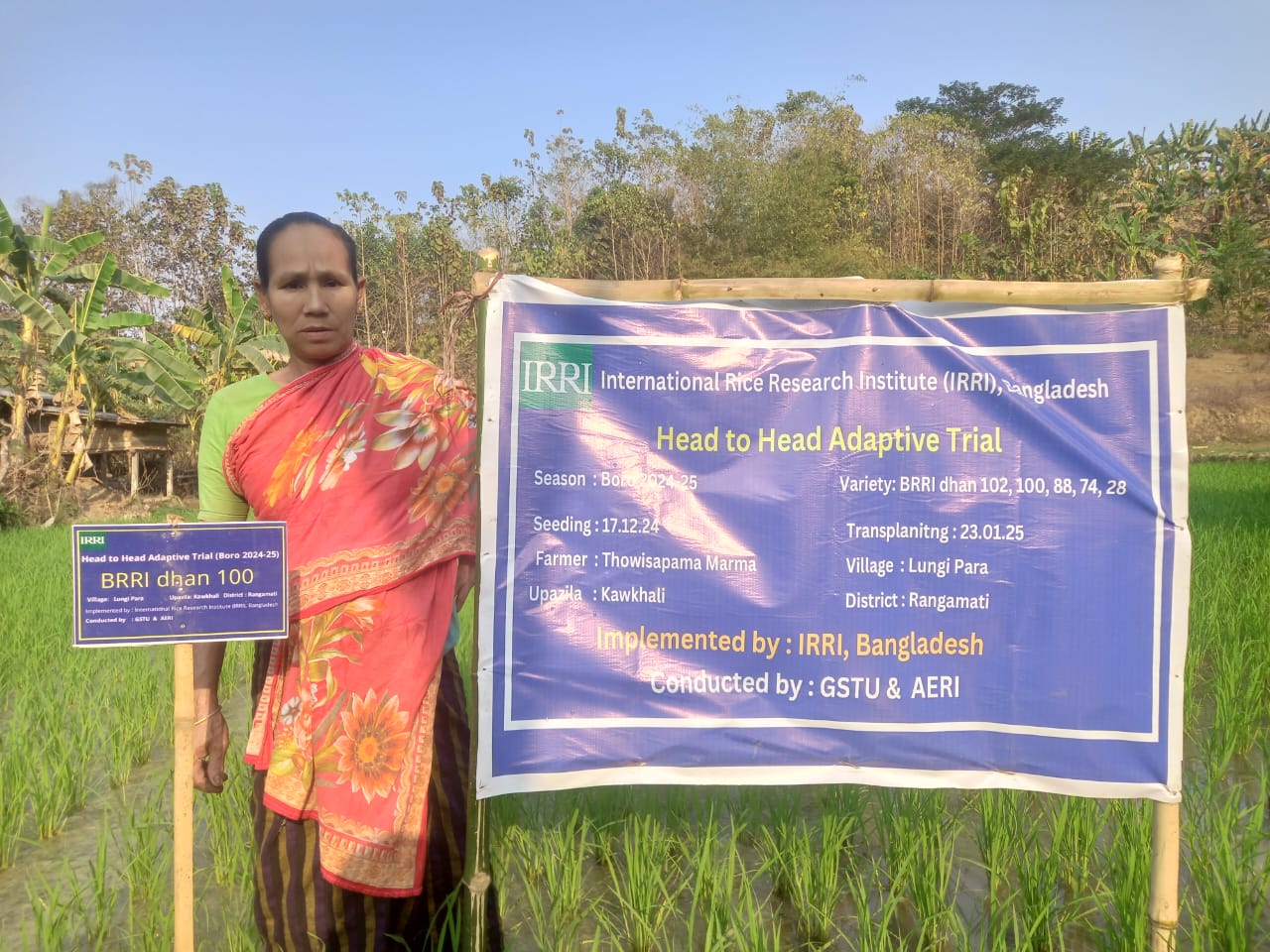
Objectives of the Women-Led Seed Producer Group
The project focuses on:
1. Enhancing Seed Quality and Availability
o The group specializes in producing high-quality rice seeds from improved and high-yielding varieties tested in HHAT trials.
o Ensuring disease-free, climate-resilient rice seeds for local farmers.
2. Promoting Women’s Leadership in Agriculture
o Providing training and capacity-building programs for women in Rice seed production, processing, and storage.
o Encouraging financial independence and agricultural entrepreneurship among women.
3. Integrating Scientific Research into Seed Production
o The women’s group works closely with agronomists from AERI, IRRI and GSTU to ensure proper seed selection and quality control.
o Field demonstrations help in educating local farmers about the benefits of using certified seeds.
4. Economic and Social Impact
o Increasing household income by creating a sustainable seed business model.
o Strengthening rural economies by reducing dependency on external seed suppliers.
o Encouraging the participation of women in decision-making processes in agricultural communities.


How IRRI, AERI, and GSTU Contribute to this Initiative?
• IRRI: Provides scientific guidance, high-quality seed varieties, and training guideline for seed production.
• AERI & GSTU: AERI Conducts research trials, workshops, and training programs to ensure best practices in seed production. AERI & GSTU Implements the program, introducing mechanization and processing techniques for efficient seed production.
Challenges and Future Prospects
Despite its success, the initiative faces logistical challenges, such as market access and supply chain management. To overcome this, plans are in place to:
• Expand seed distribution networks to reach more farmers.
• Introducing digital platforms for marketing and selling seeds.
• Strengthen collaborations with government and private sector stakeholders for funding and technical support.
Conclusion
The Head-to-Head Adaptive Trial (HHAT) of modern rice varieties and the women-led Rice seed producer group in Rangamati highlight the power of agricultural research and community-led initiatives. These projects, supported by IRRI, GSTU and AERI demonstrate that scientific innovation and women’s empowerment can drive sustainable agriculture in Bangladesh.
By investing in high-yielding rice varieties and empowering women in Rice seed production, these initiatives are paving the way for a more resilient, productive, and inclusive agricultural sector.
Contact:
If you have any questions, thoughts, or suggestions, please contact us or join our social media networks.
Email us: agribusinessedu@gmail.com, info@agribusinessedu.com
Feel free to comment:
Your email address will not be shared with anyone.
Join our LinkedIn group
https://www.linkedin.com/groups/13943442/
Join our Facebook group
https://www.facebook.com/groups/agribusinesseducationandresearchinternational
You May Read: Producers Surplus of Agricultural Commodities – Agribusiness Education and Research International
You May Read: What are the Characteristics and Traits of an Entrepreneur? – Agribusiness Education and Research International
You May Read: Why is market information important? – Agribusiness Education and Research International
You may read: Agribusiness how it works? – Agribusiness Education and Research International
You may read: Covid -19 Pandemic Impact on Agribusiness – Agribusiness Education and Research International
You may read: What is Agribusiness? – Agribusiness Education and Research International
You may read: Agribusiness in Bangladesh – A Basic Introduction – Agribusiness Education and Research International
You may read: Organic Agriculture Introduction – Agribusiness Education and Research International
You may read: What is Sustainable Agriculture? – Agribusiness Education and Research International
What is Permaculture? – Agribusiness Education and Research International
E-Commerce and Supply Chain Finance – Agribusiness Education and Research International
What is Supply Chain Finance? – Agribusiness Education and Research International
What is an agile supply chain in Agribusiness? – Agribusiness Education and Research International
What is Supply Chain Management in Agribusiness? – Agribusiness Education and Research International
Supply chain management and Agribusiness – Agribusiness Education and Research International
Factors Affecting Supply Elasticity – Agribusiness Education and Research International

